
Quantum computing is coming — and Corporate America isn't ready
Most companies are about as prepared for quantum computing's arrival as Blockbuster was for Netflix
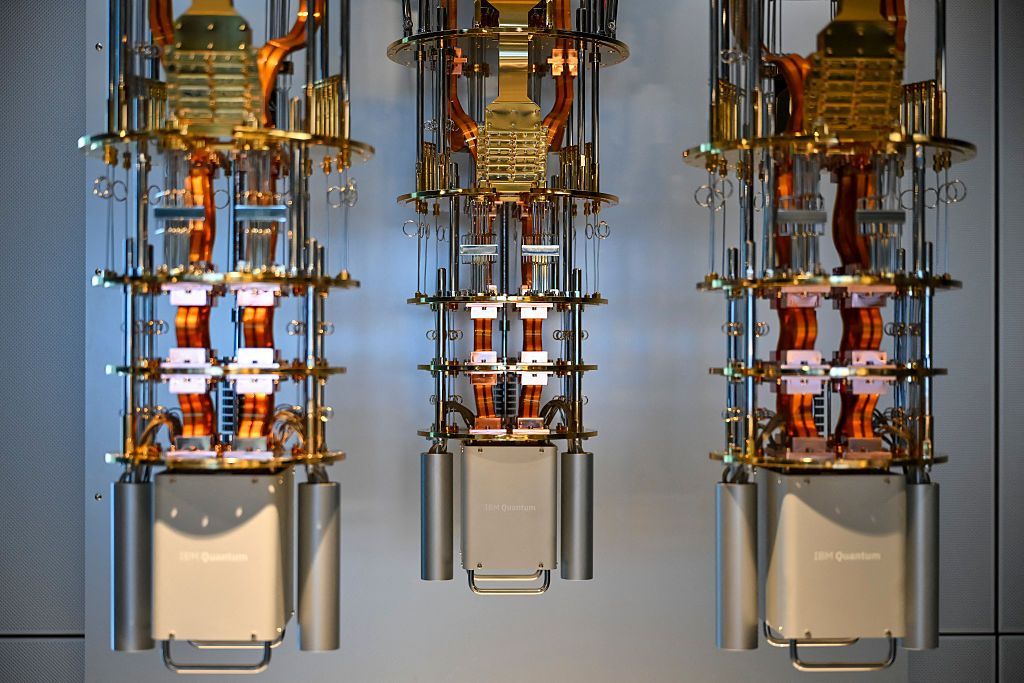
Getty Images
A version of this article originally appeared in Quartz’s members-only Weekend Brief newsletter. Quartz members get access to exclusive newsletters and more. Sign up here.
Quantum computing has been one of tech's most reliable running jokes for decades: always revolutionary, always five years away. But while CEOs sprint to slap "AI-powered" on everything they sell, quantum researchers keep quietly achieving breakthroughs that suggest the perpetually distant future might arrive during an extremely inconvenient news cycle.
Microsoft $MSFT announced it created a new state of matter to power quantum computers earlier this year. In December, Google $GOOGL built a machine that solved in five minutes what would take conventional supercomputers longer than the age of the universe. IBM promises a fault-tolerant quantum computer, which can correct its own errors and run reliably, by 2029, cutting down the perpetual five-year timeline to four.
Even skeptics are changing their tune. Nvidia $NVDA CEO Jensen Huang, who previously suggested quantum computers were 15 to 20 years away from being useful, declared in June that "quantum computing is reaching an inflection point" and said "we are within reach" of solving real problems in the coming years.
The problem? Unlike deploying ChatGPT, quantum readiness requires years of preparation that most companies haven't started. Quantum computers harness the strange behavior of subatomic particles — which can exist in multiple states simultaneously — to process information exponentially faster than traditional computers for certain calculations.
The machines require extreme cooling (hundreds of degrees below zero) and specialized chips that look nothing like conventional semiconductors. There are maybe a few thousand people globally who understand both quantum mechanics and its business applications. Most organizations are about as prepared for quantum's arrival as Blockbuster was for Netflix $NFLX.
This blindness has consequences. Companies that started quantum experiments years ago are quietly building institutional knowledge while competitors focus elsewhere. More than 1,100 quantum patents have been filed in the past five years, according to Deloitte's analysis. The consulting firm recently issued scenario planning research warning that the few organizations continuing quantum investments during the AI frenzy may find themselves holding significant advantages when commercial applications suddenly arrive.
The talent war has already started
Perhaps the biggest barrier to quantum readiness is human capital. Unlike AI, where companies can retrain existing developers or hire from a growing pool of data scientists, quantum computing requires specialized knowledge of quantum mechanics, advanced mathematics, and physics that can't be learned in a weekend bootcamp.
The numbers are stark: Analysts estimate 250,000 quantum computing jobs will be needed by 2030, but quantum job postings grew only 4.4% over the past year and actually declined month-over-month, according to the Quantum Technology Workforce Monitoring Report. The few thousand qualified experts are being snapped up by tech giants and well-funded startups, creating a bidding war that smaller companies can't win.
Universities are struggling to scale quantum education programs fast enough. The University of Chicago offers an eight-week quantum course, but it's designed for people with up to 10 years of experience in physics, computer science, or engineering — hardly making it a mass retraining solution.
Meanwhile, some companies are already extracting value from quantum experiments. Moderna $MRNA is using IBM's quantum computers to explore drug design. For Moderna’s COVID vaccine alone, there were 10^623 different molecular options to test, impossible for classical computers. Comcast $CMCSA is exploring if quantum could solve internet traffic optimization across its million miles of fiber and cable. Financial services firms are testing quantum algorithms for portfolio optimization and risk modeling that could run billions of simulations.
The risks are coming
The technology also creates preparation requirements for companies that may never build their own quantum teams. The same computers powerful enough to optimize drug discovery could break most current encryption, potentially exposing everything from credit card transactions to state secrets. Security experts warn that criminals may already be collecting encrypted data today to decrypt once quantum computers become capable — a "harvest now, decrypt later" strategy that makes upgrading cybersecurity urgent even before quantum becomes commercially viable.
The irony is palpable: Just as quantum computing approaches commercial viability, corporate attention has never been more focused elsewhere. AI implementation dominates IT budgets, board meetings, and strategic planning. Quantum feels abstract and distant compared to the immediate pressure to integrate AI across business operations.
But quantum isn't just better software. It's fundamentally different computation, like the difference between a light bulb and a laser, according to Scott Buchholz, Deloitte's quantum leader. The applications, infrastructure requirements, and competitive implications are unlike anything businesses have experienced.
The preparation window is closing precisely when companies are least equipped to notice.